The EU legislator, recognizing the current distrust of a significant part of society towards crypto-asset markets, as well as the regulatory uncertainty regarding conducting business related to crypto-assets or their issuance in the European Union, decided to design the MiCA (Markets in Crypto-Assets) regulation.
One of the EU legislators' responses to the identified problems was to establish uniform regulations for all EU member states. This approach, according to EU legislators, is intended to ensure the development of the crypto-asset market and thus contribute to the creation of new opportunities in digital services, alternative payment instruments, and sources of financing for entrepreneurs.
Harmonization of regulations in the EU and its impact on companies
Until now, conducting business related to cryptoassets or issuing them within the European Union required analyzing the legal situation of the given Member State, as well as EU legislation, in order to adapt the business to the given legal system. This often involved the time-consuming and costly process of establishing a new type of business and, as mentioned at the beginning, legal uncertainty.
The MiCA regulation aims to prevent these problems by creating uniform regulations for all member states, thanks to which entrepreneurs wishing to provide services related to cryptoassets or their issuance in the future will not only be able to establish their new business in the member state of their choice under the same conditions, but also more easily provide their services in the markets of other member states.
Challenges related to new regulatory requirements
The new EU regulations will significantly impact existing entrepreneurs providing services in the field of crypto-assets and issuing crypto-assets, as well as entrepreneurs who are planning such activities.
The MiCA Regulation introduces a licensing requirement for the provision of crypto-asset services, as well as for the issuance of asset-linked tokens (ART tokens) and e-money tokens (EMT tokens). This requires meeting a number of requirements imposed by EU lawmakers, depending on the business's planned activities.
The future of the EU cryptocurrency sector after MiCA implementation
It is difficult to predict the long-term effects of the MiCA regulation. However, from the perspective of the EU legislator, it is particularly important to emphasize the ease of conducting cross-border activities related to crypto-assets or their issuance within the European Union, as well as the reduction in legal uncertainty. Furthermore, the EU legislator's attempt to increase trust in crypto-asset markets will undoubtedly have some effect, but at the cost of burdening businesses with new requirements and obligations.
To dispel any doubts, we invite you to a free webinar!
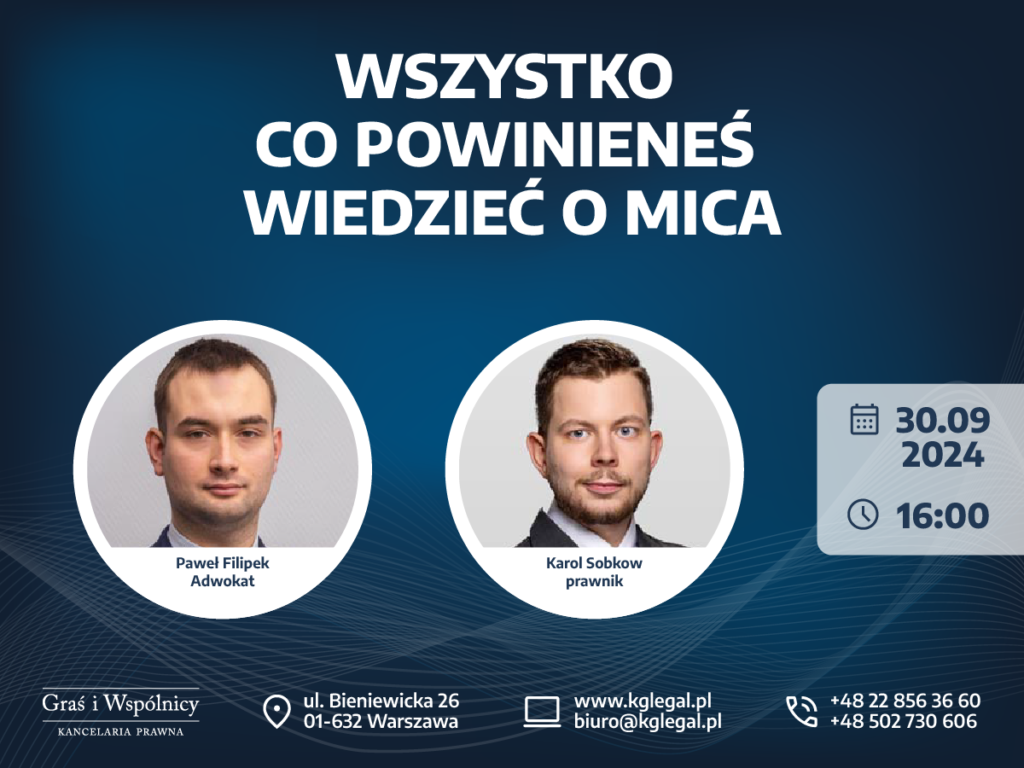
We cordially invite those interested in, conducting, or planning to conduct business in the crypto-asset sector to a webinar organized by our Law Firm, which will be devoted entirely to the MiCA regulation. The webinar is scheduled for September 30, 2024, at 4:00 PM. Registration is available by clicking the link .
This alert is for informational purposes only and does not constitute legal advice.
Legal status as of September 19, 2024
author: